About eighteen years ago I finished my studies. I remember that time as a series of constraints. Some things took weeks to build. Some needed a team you didn't have. Others needed a skill you would never find the time to learn. Most ideas stayed ideas.
Many of those constraints have now disappeared. I can't quite decide whether that happened thanks to AI or because of it, and I think that uncertainty deserves some attention. Earlier this week I spoke at the Mindstone AI Meetup, hosted at Epitech in Lyon, about work and creativity in the age of AI. The talk asked two questions: what becomes possible, and what still matters?
I answered them wearing three hats. By day I am an associate professor (in French, an enseignant-chercheur) at CPE Lyon and a researcher at the LIRIS laboratory (CNRS). By night, or at least on weekends, I am someone who likes to make things. This essay follows the talk and adds a little more room to think.

Data, space and time
All my research comes back to three words: data, space and time. Data is the raw material. Space can be a map, a building or a 3D city model. Time is where it gets interesting, because time carries change. My PhD and my postdoc were both about change: what it means for something to change, and how to represent it.
These days that lens points at urban data science and cultural heritage, and at making complex relationships visible, sometimes literally, as 3D views of Lyon you can explore. I also think a lot about memory. I love the French word mémoire, because it sounds personal in a way that "memory" doesn't quite manage. Behind all of this sits one question: how can heterogeneous data become knowledge that humans can explore?
Three current projects try to answer it in different ways:
- AGAPE, funded by the French National Research Agency (ANR), works on iconographic heritage: old photographs, very old postcards and other images of places. We link them to each other and to today's images, including the photos people post on social media, and position them in 3D. That lets you see how a street or a building has changed over centuries.
- IA.rbre, with the Métropole de Lyon, uses aerial imagery, LiDAR and urban data to study climate resilience. We map where trees could be planted and which areas are vulnerable to heat. The name is a French pun on IA (AI) and arbre (tree).
- TAC (Thesaurus Automation Curation), with the Fondation des Sciences du Patrimoine, uses large language models to propose concepts and relations in heritage thesauri. Experts then curate and align them with existing vocabularies. Relationships that are obvious to a person are hard for a machine to state, and that is where an LLM helps.
In each project we start with more material than anyone can read and end with structured knowledge that people can explore.
Symbolic AI never left
I came to AI from the symbolic side. Between 2011 and 2014 my PhD used rules and declarative languages such as Datalog to represent knowledge about web services. Everything was explicit: you could read the semantics.
Then everything changed. First came neural networks: you can ask a vision model to find the important objects in a photograph, and it will. Then came the Transformer and large language models, which learn statistical associations at a scale that lets you ask very complex questions in plain language.
I regularly read online that symbolic AI is dead. I don't think so. TAC is a small example of why. The neural model is excellent at discovering possibilities: candidate terms, plausible relations. The symbolic layer, with explicit relations validated by experts, is what makes those possibilities organized, verifiable and reusable. Each needs the other.
Neural models discover possibilities. Symbolic models make them reusable.
Do we really need to train another model?
When you work with AI every day, it's easy to forget how much the field covers. There is symbolic AI, classical AI from long before the 1990s, statistical learning, deep learning and generative models. They have very different costs. So before starting a new project, ask yourself: does this task really need an energy-hungry model?
In IA.rbre we tried to make that question part of the method:
- Question the need. Could retrieval or explicit rules do the job?
- Reuse what exists. IGN, the French national mapping agency, has already released many AI models. How far can we get with them?
- Adapt with evidence. Fine-tune or train only when the task clearly needs it.
Count the whole cost, too: data, energy and the time of experts. Frugal AI starts before any training, when you decide what is worth computing. Choosing what to compute is itself an act of intelligence.
Code in the language you think in
Here is a constraint that I lived with for years. When I started teaching in 2017, I watched
French-speaking students struggle with the command line. Why should cd or
ls be hard to remember? Because the mnemonics are English. "Change directory" helps
you remember cd only if "directory" is a word you already know. For a French speaker
the word is répertoire, so the mnemonic doesn't help.
Around 2017–2018 I gave a talk at Capitole du Libre, the open source conference in Toulouse, proposing a multilingual command line. I sketched some ideas but was never really happy with them. Doing it properly would have taken far more time than I had.
This year, agentic coding tools arrived: Claude, OpenAI Codex and many others. I went back to that old experiment and made it much more ambitious. The result is multilingual, a programming language in which different human languages share the same program semantics:
print("Hello world")          # English
afficher("Bonjour le monde")  # Français
The built-in functions are localized, and the execution model is shared. I am not the only person working on this idea, and I don't claim it is new. What is new is that one person can now explore it seriously. The constraint that stopped me in 2018 has largely gone. I believe more people should be able to express computational ideas in their own languages.
Intelligence is a commons
Whenever you use ChatGPT, Gemini or Claude, remember whose work you are standing on. These systems learned from open source code, open data, and decades of volunteer writing and curation. AI is, in large part, the work of communities.
Wikipedia is the obvious example. Less visible is Wikidata, where knowledge is stored as simple statements: C — developer — Dennis Ritchie; C — influenced — C++. They look boring, but conversational agents use such facts every day. The next layer is Wikifunctions and Abstract Wikipedia, which aim to turn those shared facts into readable sentences in any language:
C was developed by Dennis Ritchie and influenced C++.
C a été développé par Dennis Ritchie et a influencé C++.
This matters because many language communities don't have enough contributors to write everything by hand. Knowledge is of little use to people if it isn't available in their language. As a long-time Wikidata contributor I care about this a lot. Communities also provide what data alone can't: context, correction and meaning.
Learning changes, so assessment must too
I teach C programming at CPE Lyon, and I will be honest: AI has made assessment hard. AI can produce very good code. Whether the student understands that code is a different question, and our usual tools no longer answer it.
Banning AI is not the answer. Students need to learn how to work with it, because that is the world they are entering. The fundamentals still matter, though. So I am experimenting with questions and quizzes redesigned for this new situation, with educational games, and with two complementary settings:
- Without internet: written exams where students reason about C fundamentals, trace code and explain memory. Yes, on paper, the old way.
- With AI: practical work where students build, test and debug, and then explain the code and the choices they made.
I don't have the final answer. The question I keep asking is this: when AI can produce the code, how do we evaluate what students understand?
Don't just generate an image. Build a world.
People complain a lot about AI slop, and I don't like it either. Most of it is generic, and none of it is personal. But the problem isn't that a machine was involved. The problem is how people use it.
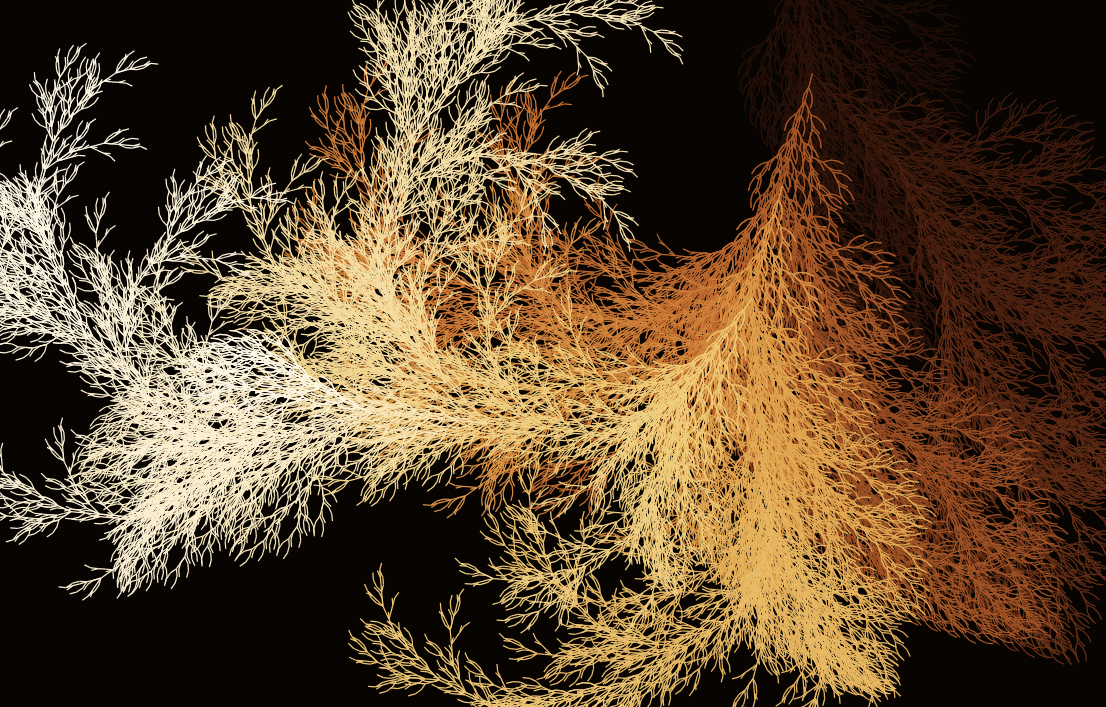
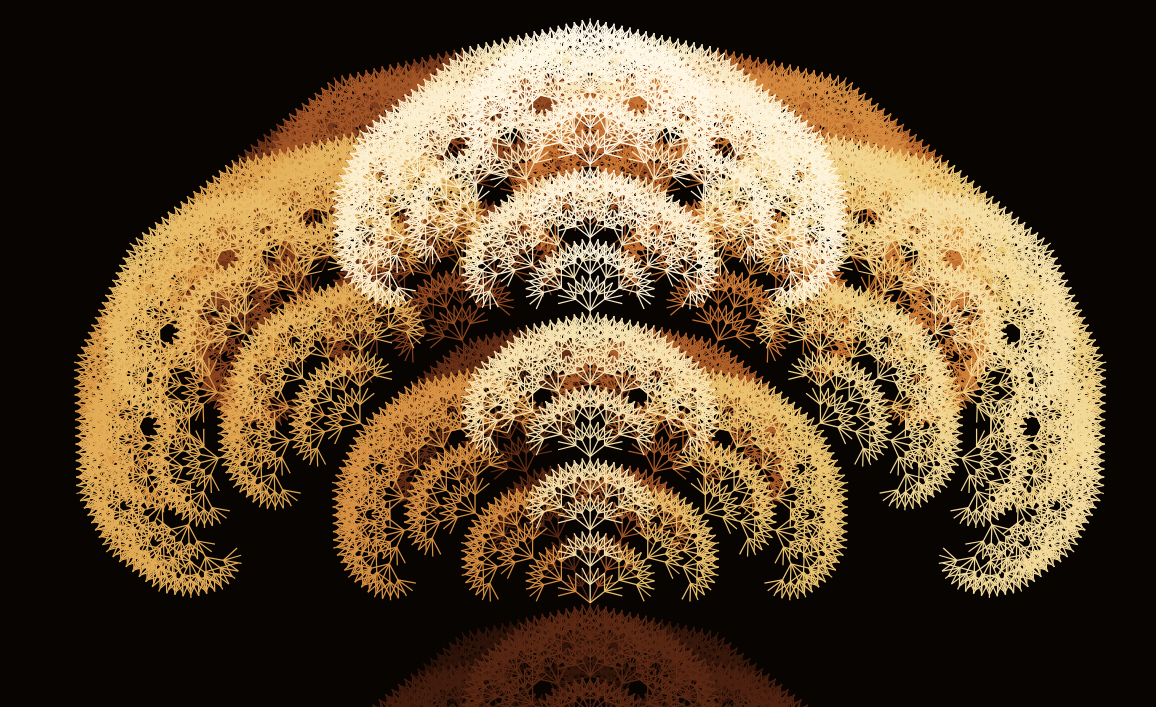
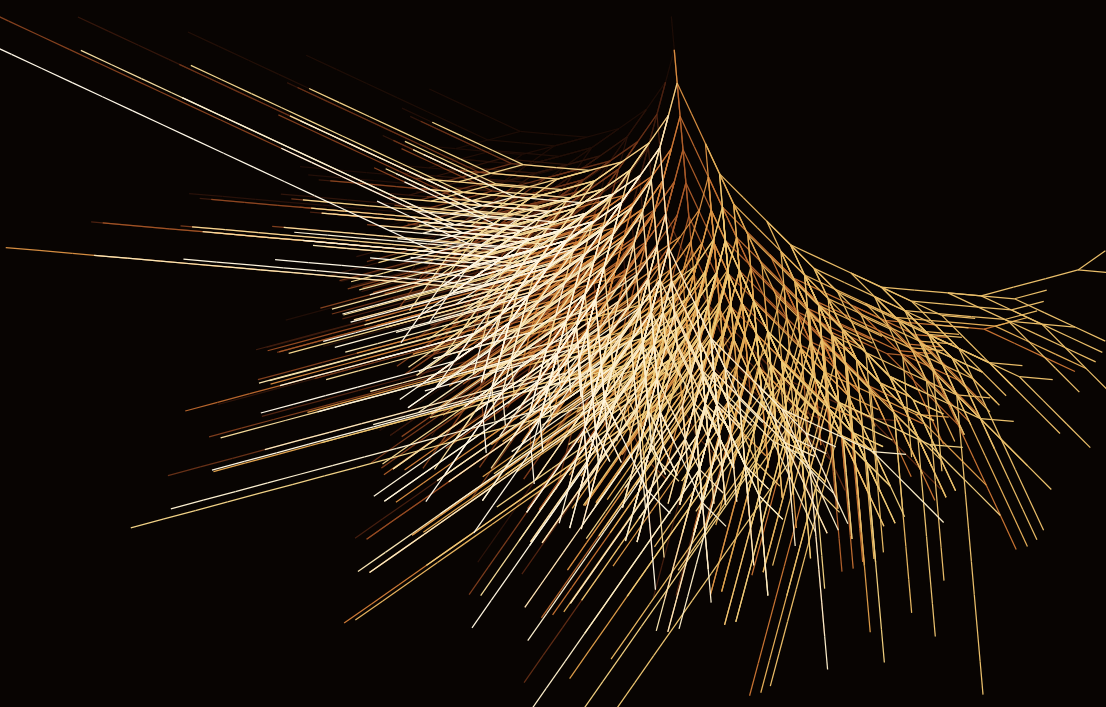
So I tried something different. Using multilingual, I wrote my programs in French (the code is public, so you can check). Instead of prompting for finished images, I went back to classical generative systems: fractals, L-systems and cellular automata. These rule systems existed long before deep learning, and I brought them back in a neuro-symbolic way. I define the rules and add some probability, AI agents help write the code, and the system produces worlds I did not fully anticipate.
It becomes a creative loop: define rules, run variations, recognize surprise, then branch, vary and observe again. The same rule set run three times gives three different worlds. When variations are endless, the interesting question changes: what makes one creation worth keeping? Answering that is still up to me.
But did your eyes see it?
I ended the talk with a photograph. On February 13, 2024, I was walking along the quai du Rhône in Lyon when the sky turned colours I had never seen there. I stopped and took the picture, and I still find it hard to believe.

Today AI can generate an image like that in seconds. As a photographer, my question is simple: did your eyes see it? A generated image may look perfect. What it lacks is the moment itself: a person standing somewhere and choosing that frame at that instant. Who chose the data? The language? The frame?
This isn't nostalgia. AI isn't perfect. It carries biases, and some of them come from what is missing: languages that are underrepresented, and knowledge that was never written down or never digitized. If all of us generate from the same models trained on the same data, we will keep producing the same things.
Abundance should widen creative diversity, not narrow it.
What still matters
Many of the old constraints really have disappeared. The multilingual command line I couldn't finish in 2018 is now a programming language. Tasks that needed a team can now be done by one curious person over a few weekends. I find this exciting, and I encourage everyone to use AI, in their work and in their creative lives.
When constraints disappear, though, choices matter more. What should we compute, and what should we reuse? Whose knowledge and whose language does a system reflect, and who contributed it? How do we check that someone understands something rather than just produced it? Which of the endless variations are worth keeping? Machines can't answer these questions for us. They need our attention, experience, responsibility and sense of meaning.
Humans are diverse, and so are our creative minds. Let's make sure our tools help us create more varied work.
This essay is based on my invited talk When the Old Constraints Disappear: Work and Creativity in the Age of AI, given at the Mindstone AI Meetup at EPITECH, Lyon, on September 22, 2026. You can watch the video, browse the slides, download the PDF or read the abridged transcript. The code for multilingual is on GitHub.